
Earlier this month, the Central government said in a reply in Parliament it had taken measures to double farmers' income by the end of FY23 and the progress made so far indicated it was "on the right track". However, a close look at the data and at the assumptions made shows that as of now, it appears the country is unlikely to achieve the goal in real terms.
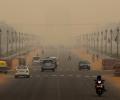
The top court did some tough-talking and had warned that the administration at large will be made accountable even if there is a single incident of stubble burning henceforth.

Unhappy with the bickering within the ruling coalition of the Congress and Nationalist Congress Party in Maharashtra, Chief Minister Ashok Chavan exhorted his ministers to adhere to the 'coalition dharma'.

From NITI Aayog to industry leaders to the Reserve Bank of India, all are apprehensive that any major increase in MSP, following the 2018-19 Budget announcements, would push up prices, if not immediately, in the next six to eight months after the decision is taken.

'Modi came out with this huge announcement that he has given a historic price rise to farmers.' 'It was actually a fake price. He did not give the price mentioned in the BJP's election manifesto.' 'So, Modi gave an incomplete price rise and publicised it as if he has completed his job.' ''This government has surely proved that it does not care about farmers in any way.'

Besides, the government would also undertake and promote steps for water conservation and curbing extraction of underground water, which is depleting the water table and is a matter of concern, the minister said.

'To bring about a paradigm shift in farmers's income, we need to change our approach to agriculture, and transit from the narrow prism of cultivation to a full-fledged enterprise, by building all associated supply chain linkages.' 'This alone will make the farmer an entrepreneur in his own right.'

"If we had the numbers, we wouldn't have waited for anyone. The Congress and the NCP didn't cross the 100 mark...we will work as a responsible opposition," Pawar said.

'No one talks about the Mumbai riots anymore, though like Delhi 1984, the guilty have not been punished. In Gujarat, many powerful leaders of the state's ruling party are in jail for their role in the riots... In Mumbai, only one politician of the Shiv Sena, a former MP, was convicted of hate speech, along with two other Shiv Sainiks, one of whom was a corporator and the other a junior functionary... So why the apathy? Could it be because despite these statistics and the widely-publicised findings of the Srikrishna Commission, what remained in public consciousness was the violence by the Muslims, thanks to a highly efficient Sena propaganda machine? There's no demand for it, but would an SIT probe into the closed cases of the Mumbai riots help today?' The fadeout of Mumbai's riots from public debate can be called a triumph of the communal State, argues Jyoti Punwani.
 © 2026 Rediff.com - Advertise with us - Disclaimer - Privacy Policy - Sitemap - Feedback - About us - Terms of use - Grievances